Four nights. The points keep Jupiter as a center and change their order. Looking dated before the names.
After Sidereus Nuncius, Venice, 13 March 1610. Working English. Not a facsimile of the book.
World of WorldsOne wandering light becomes a system with moons. Later, resonance, timing, and navigation.
Venus · a test of cosmology
One relationship: full Venus at large size kills a simple nested model. Tycho still hosts the appearance. Heliocentrism is not uniquely proven.
Evening StarOne light, two appearances. Phases later pressure cosmological models. Radar then shows another world.
Saturn · a change of category
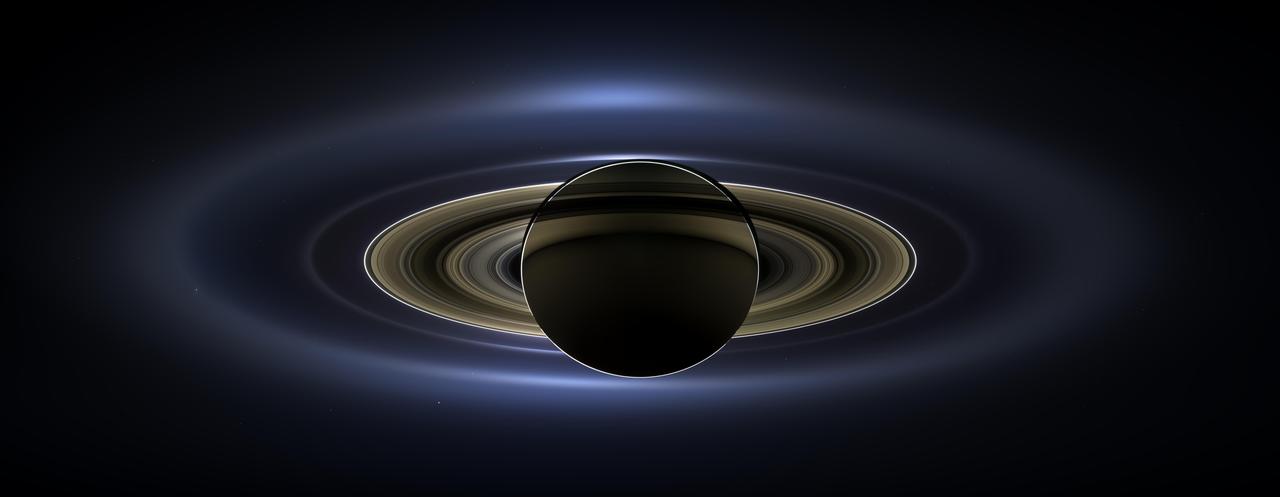
NASA / JPL-Caltech / SSI · PIA17172 · DOCUMENTARY IMAGELater seeing. Not Galileo’s 1610 tri-form. The ring is a shore. Copy does not sit in it.One relationship: the object was never three bodies. Huygens, 1659. The instrument changed the category.
Galileo · 30 July 1610
Altissimum planetam tergeminum observavi.
I have observed the highest planet tri-form. Then the appendages vanish. Huygens, 1659: a detached inclined ring. The object was never three bodies.
Letter to the Medici, 30 July 1610. Working English after the published wording. Not a critical edition.
World of RingsThe slowest naked-eye wanderer becomes a telescopic puzzle, then a ring system and a dynamical world.